
Marine Biologging (DiveDB)
Dr. Jessica Kendall-Bar, Scripps Institution of Oceanography
Whitecap built the multimodal database that turns years of animal-borne sensor, video, and event data into one queryable research archive.
Problem Statement
Biologging researchers tag animals with sensors recording depth, movement, heart activity, and video, but that data arrives as thousands of mismatched files on different clocks and sampling rates. Stitching years of multi-sensor deployments together by hand made it hard to ask a single question across a whole study, or share the archive with collaborators.
Collaboration
We built DiveDB with Dr. Jessica Kendall-Bar at Scripps Institution of Oceanography, which supplies the tagged-animal deployments: elephant seal dive, EEG and ECG, accelerometer, video, and metadata records. DiveDB is now shared infrastructure across her Marine Eco-Physiology Collaborators, including Life in the Deep, a visualization app we also built.
Technical Approach
Three Iceberg tables unify sensor, event, and state data
DiveDB stores every tag deployment in three Apache Iceberg tables: a wide time-series table, a point-events table, and a state-events table. Researchers query years of multi-sensor data as one lake instead of stitching files by hand, on a warehouse that runs on S3 or Ceph object storage.
Apache Iceberg · Amazon S3 · Ceph
DuckDB layer resamples signals and exports EDF files
A DuckDB query layer sits on top of the Iceberg lake and resamples data on the fly, downsampling or upsampling any signal to the resolution a researcher asks for. It also exports selected recordings as EDF, the standard format most third-party signal-analysis tools expect.
DuckDB · Apache Iceberg · EDF format
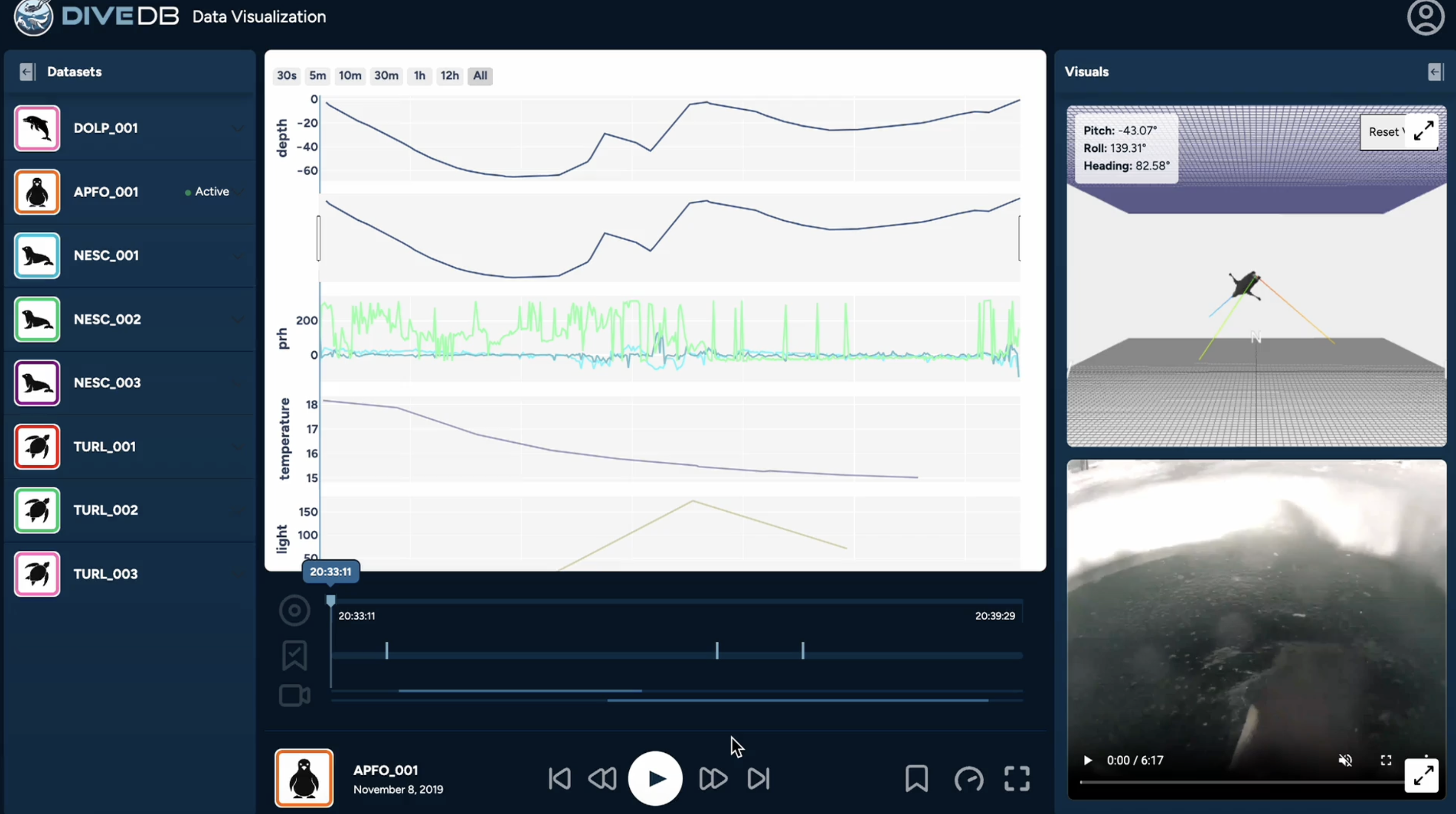
A 3D animal model syncs live with video and sensors
A Three.js model of the tagged animal's orientation plays back in real time on a shared timeline with its dive video and ECG or depth traces. Scrubbing one view moves all three together, so a reviewer can see exactly what the animal was doing at any moment.
Three.js · Immich · WebGL
Results
- Years of multi-sensor tag data now live in one queryable archive instead of scattered files.
- The Kendall-Bar Lab uses DiveDB for its elephant seal dive, EEG, ECG, and video research.
- DiveDB is now shared infrastructure across the Marine Eco-Physiology Collaborators' visualization projects, including Life in the Deep.
Who uses it
Kendall-Bar Lab, Scripps Institution of Oceanography
Stores and queries elephant seal dive, EEG and ECG, accelerometer, video, and metadata records in DiveDB for its biologging research.
Marine Eco-Physiology Collaborators
Share DiveDB as common data infrastructure across the group's biologging and visualization projects, including Life in the Deep.