
Sensing Sound
Seymour Marine Discovery Center, UC Santa Cruz
With Ian Costello (game engine lead) and Dr. Jessica Kendall-Bar
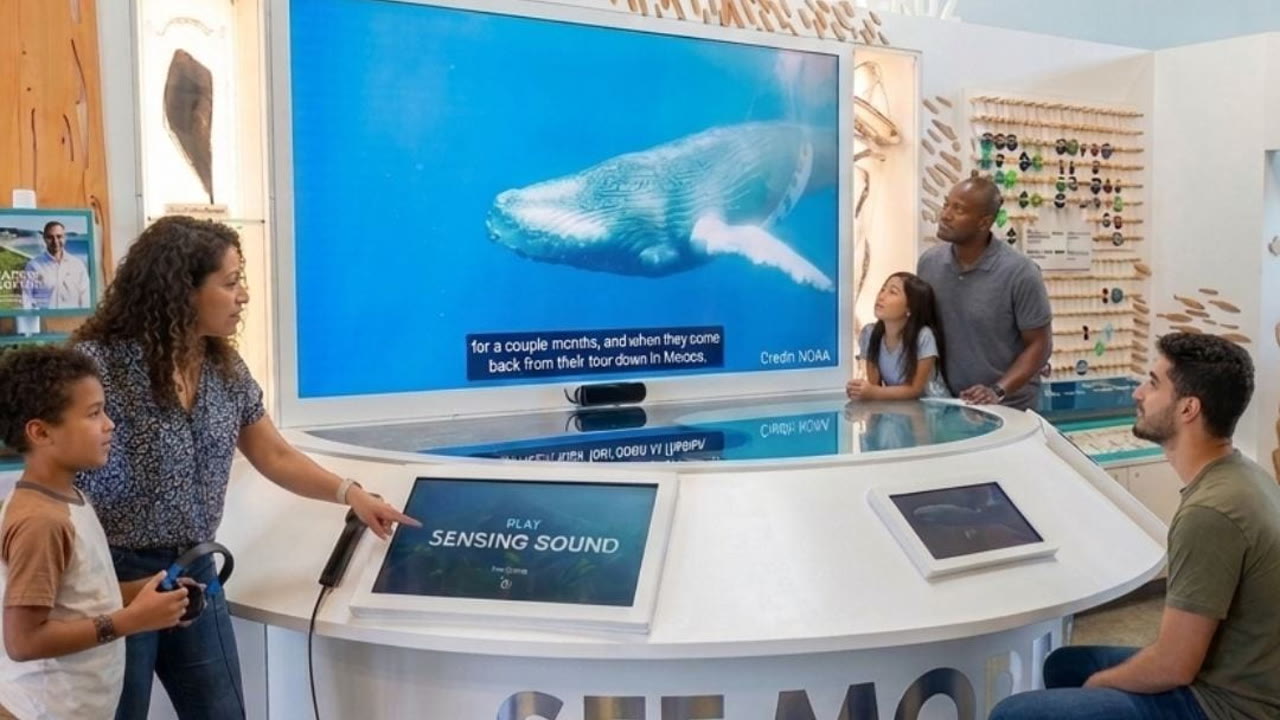
Sensing Sound is a public museum exhibit at UC Santa Cruz's Seymour Marine Discovery Center that turns real ocean-acoustics research into a game.
Problem Statement
Research on how marine animals hear, and how ship noise shrinks the distance their calls travel, usually stays in journals and lab reports. Most people never get to experience it. The Seymour Marine Discovery Center wanted that science on its exhibit floor, in a form families and school groups would choose to play with and remember.
Collaboration
We built Sensing Sound with game engine lead Ian Costello and Dr. Jessica Kendall-Bar for the Seymour Center's See More HQ exhibit. Acoustics research from the UC Santa Cruz Pinniped Lab, MBARI, and the Middlebury Institute supplies the science, and we turned it into a touchscreen game that has been open to the public since June 2026.
Technical Approach
A museum exhibit anyone can walk up to
Sensing Sound is a permanent station in the Seymour Center's See More HQ exhibit, open to every visitor. There is no account and no manual to read first: visitors pick an animal and an ocean condition and hear the result. Exhibit text in English and Spanish lives in a shared spreadsheet, so staff can update it without a developer.
Google Sheets · PapaParse
A game engine turns acoustics into play
We built the exhibit in Unreal Engine so the science feels like a game, not a lecture. Visitors hear how far a whale or dolphin call travels under calm, winter, storm, or cruise-ship noise, driven by a real sound-propagation model and NOAA SanctSound recordings rather than a toy formula.
Unreal Engine · NOAA SanctSound data
Research deployed on a physical exhibit floor
The game runs fully offline on dedicated kiosk hardware, built to run all day on the exhibit floor without an internet connection. The same dataset also powers a companion website, so the research reaches visitors in the building and again at home.
Unreal Engine · React
Results
- Sensing Sound has been open to the public in See More HQ since June 2026 and is still on display.
- Families and school groups experience real acoustics research as a game rather than a paper.
- Museum staff update exhibit text in English and Spanish without a developer.
- The same research reaches visitors twice: on the exhibit floor and on the companion website.
Who uses it
Seymour Center visitors
Families, school groups, and the public play the game at a touchscreen station in the See More HQ exhibit.
Seymour Marine Discovery Center, UC Santa Cruz
Hosts Sensing Sound in its permanent See More HQ exhibit, where staff and volunteer educators run the exhibit floor.
Science partners
The UC Santa Cruz Pinniped Lab, MBARI, and NOAA's SanctSound program supply the hearing and ocean-noise data behind the game.
Workshops and events
Exhibit · June 2026 – present
See More HQ, Seymour Marine Discovery Center
Opened as a station in the center's permanent See More HQ exhibit and is still on display as a public engagement exhibit.